 English
 Arabic
 Chinese (Simplified)
 Dutch
 French
 German
 Italian
 Portuguese
 Russian
 Spanish

Every week a board sits unbuilt, your runway burns, and milestones slip. For hardware startups, delay is the quiet killer.
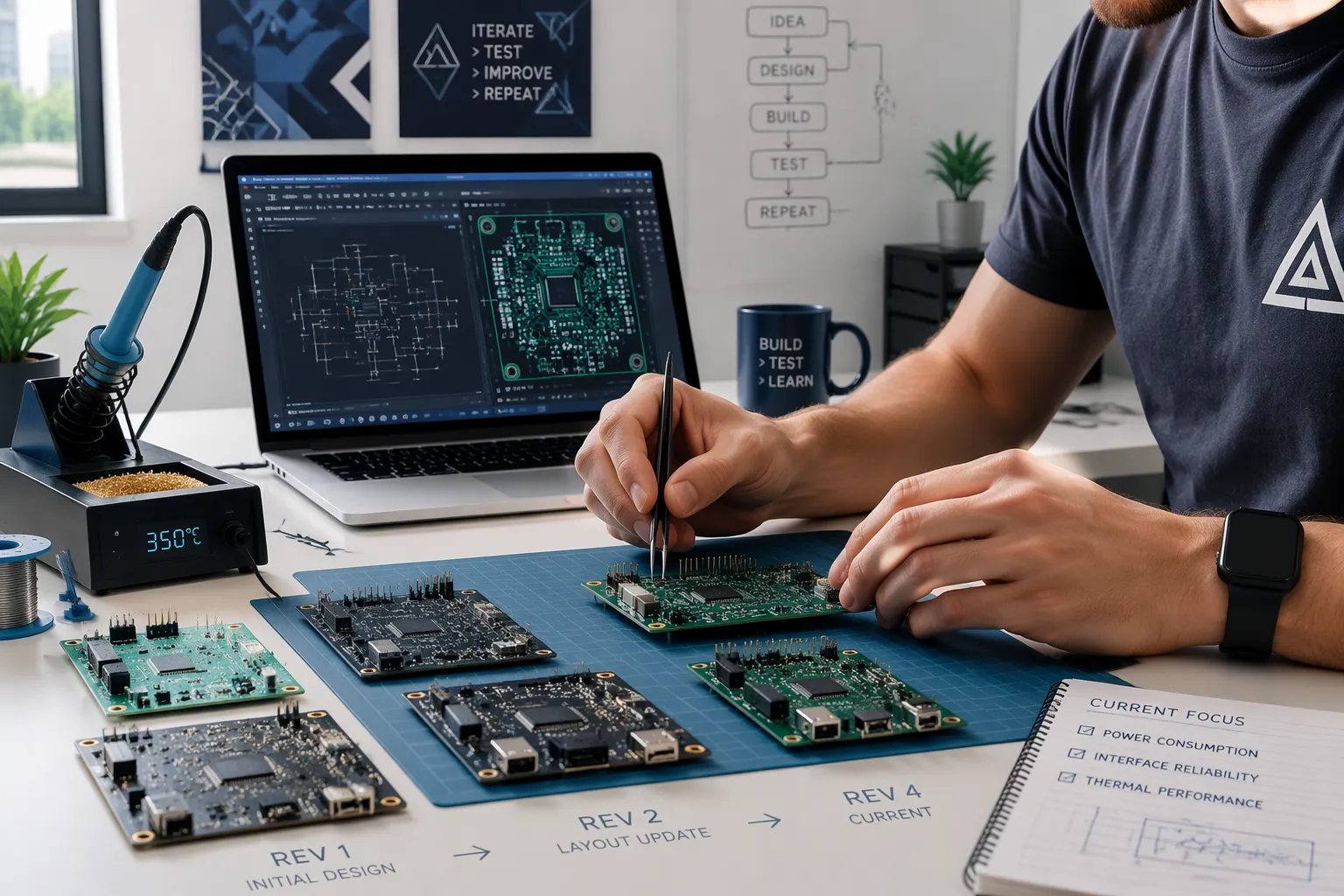
Fast iteration is a process problem as much as a manufacturing one. A repeatable loop beats rushing any single step. You shorten the loop with a structured iterate cycle, acceleration techniques, stage-based file prep, mistake avoidance, and partner selection.
The payoff is concrete. Better pcb prototype iteration speed shortens time-to-market, lowers prototype spend, and cuts respins. Strong pcba prototyping for startups starts with process discipline.
Printed circuit boards reward teams that plan each pass. A fast turn pcb prototype partner keeps your pcb prototype moving, and steady prototype iteration speed compounds across builds.
Key Takeaways
Use a four-step cycle: design, review, build, and test. Repeat it to find problems early and make your board better with each pass.
Use cloud tools and DFM checks to find and fix problems before you build. This saves time and money by stopping rework.
Make separate files for each prototype stage: EVT, DVT, and pilot. Files that are complete keep your build moving with no delays.
Don’t make common mistakes like incomplete BOMs or missing test points. Check your files carefully before you send them to your manufacturer.
Pick a manufacturing partner that matches your stage. Quick-turn shops work well for early prototypes; full-service manufacturers help with production.
Why PCB Prototype Iteration Speed Matters
Rapid prototyping lets you find design problems early. Each pass teaches you something new about your board. Faster passes mean more learning for each dollar. That is why pcb prototype iteration speed matters so much for hardware startups.
The Cost of a Slow Loop
A slow loop drains your resources in several ways. DEM Manufacturing notes that every extra week adds engineering labor beyond the original plan. It also adds repeat costs for tooling and materials. Lost revenue comes next. A stalled prototype means stalled sales, and competitors can move faster while you wait.
Low-volume orders also come with their own penalties. JLCPCB points out that many assembly houses set minimum order quantities and high setup fees. So you may need to order fifty boards when you only want five. Long lead times make the problem worse. One vendor makes the board while parts come from several distributors, each with its own shipping schedule. PCB Cart adds that poor-quality prototypes may fail early checks. That triggers redesign cycles and more engineering hours. Supply chain gaps and late launches add to the bill.
The Four-Step Iterate Cycle
A structured cycle shortens every pass. The loop runs design, review, build, and test. ProtoExpress describes design iteration as improving the design based on test results. You fix unexpected problems and fine-tune the board before mass production.
The cycle repeats until the design is solid. ProtoExpress notes that two to three iteration cycles are usually ideal for a reliable, well-refined design. More cycles may point to deeper issues in planning, component selection, or layout. Use EVT results to fix performance bottlenecks and reliability concerns before you move to design validation. This discipline is the heart of pcba prototyping for startups. It keeps the speed of pcb prototyping high and makes validating designs repeatable. Teams that master prototyping iteration quickly build a rhythm that carries through every stage.
PCBA Prototyping for Startups: The Iterate Cycle

Cloud tools and DFM checks turn the four-step loop into a tight, repeatable rhythm. This section shows you how to run both without adding extra work.
Cloud Collaboration and Design Reviews
Cloud-based design tools keep your engineering team productive during every pass. Altium notes that these platforms cut out needless back-and-forth messages. They also bring the manufacturer into the same space as the design team. That speeds up design review during each revision and gets your board into production faster.
You can tag design changes for DFM as comments on specific board areas or components. Your fabricator then points out required fixes right in the design documents. Cloud tools also let your fabricator suggest other parts and add them to the BOM before production. Revision tracking matters too. Git-based platforms let you go back to an old revision if a change goes wrong. Giving your manufacturer cloud access speeds up output file creation and removes email chains.
The table below compares common options.
Tool | Best for | Key strength | Main limit |
|---|---|---|---|
Flux | Browser-based shared PCB design | AI agent, real-time editing, comments | Internet connection required |
Altium Develop | Cloud collaboration around Altium data | Altium Designer plus Altium 365 workspace | Windows desktop design application |
EasyEDA Pro | Online schematic and PCB editing | Browser design and component libraries | Browser and desktop client |
OrCAD X OnCloud | Cloud data management for OrCAD X teams | Centralized design data, real-time collaboration | Desktop design with cloud service |
Upverter | Browser-based board design | Schematics, routing, 3D preview | Browser-based design |
CADLAB | Version control and review for PCB files | Git-based history, visual diffs, annotations | Review tool, not design software |
KiCad with cloud workflow | Open-source desktop design plus cloud review | KiCad files plus Git-based history | Separate service required |
Pick the tool that fits your team’s workflow. No single platform works for every hardware startups team.
Increasing PCB Prototype Iteration Speed with DFM
Design for manufacturability reviews catch problems before they reach the line. Ninja Circuits defines DFM as a structured review of layouts, component choices, and manufacturing files. This review finds issues that cause defects, delays, and respins before production. Run a dfm and dfa review before every build.
Check these items each time:
Pad sizes and land patterns match your component footprints.
Spacing between pads, traces, and holes meets your fabricator’s capabilities.
Surface finish fits your assembly process and component types.
BOM matches the design exactly, with no obsolete or unavailable parts.
Silkscreen stays off pads and vias.
Sierra Circuits recommends running targeted checks in small batches at each design stage instead of all at once. PCB Net notes that DFM mistakes directly cause tombstoning, bridging, and misalignment on the line. Each defect lowers yield and forces rework. Catching these issues early stops the respin cycle that burns weeks and thousands of dollars.
DFM reviews cut rework without requiring one tool. You apply the same discipline whether you use a free checker or your fabricator’s report. This step is where increasing pcb prototype iteration speed pays off most. A clean DFM pass means your fast turn pcb prototype moves straight to prototype pcb assembly without a rework loop.
Treat validation as part of the same habit. Confirm every design change against your test plan before you release files. That discipline keeps prototype iteration speed high across every pass.
File Prep by Prototype Stage
Your file package should fit the stage of your build. Early passes need enough data to build and test. Later passes need documents that are clear enough to repeat the build without questions.
EVT and DVT File Checklists
At EVT, send the basic package. Include Gerber files, the BOM, assembly drawings, and your test requirements. This package lets your partner run prototype pcb fabrication and send back boards you can measure.
DVT asks for more. PCB Cart lists the files required into DVT: revised files with a revision letter on every item, approved alternates, programming files, test specifications, and workmanship and inspection requirements. Expect outputs too. These include a first article inspection report, X-ray results for BGA and bottom-terminated parts, and a list of any deviations.
Stage | Files required into DVT |
|---|---|
Into DVT | Revised files with revision letter on every item, approved alternates, programming files, test specification, workmanship and inspection requirements |
Outputs | First article inspection report, X-ray results for BGA and bottom-terminated parts, a list of any deviations |
Pilot Stage: Tightening Files for Production
Pilot files differ from DVT files in one key way. They must support repeatable production, not a single build. Seeed Studio states that material information, drawings, assembly documents, and test documents must match the relevant design revision. If validation leads to design changes, update the documents for later production too.
Seeed Studio also lists what to confirm before pilot production:
Standard operating procedures are finalized and cover the relevant production steps.
Quality inspection specifications cover materials, processes, and testing.
Critical component and material samples are approved.
Issues in the pilot production report are closed.
Clearer documents speed the next build. Your manufacturing team works from clear procedures and inspection specs. PCBGogo adds that a pilot lot gives direct evidence of conformance to drawing notes, dimensional results, electrical-test performance, and assembly yield. For hardware startups, this is where design validation becomes proof.
KING FIELD accepts Gerber file and BOM list submission for tailored designs. Send files, BOM, assembly data, and test requirements together for each prototype builds pass. A fast turn pcb prototype shop can then start prototype pcb assembly without waiting on missing data. Treat every pcb prototype as a documentation exercise, and your pcb prototyping rhythm stays steady.
Common Mistakes That Delay Iterations
Incomplete Files and Rework Loops
Most delays in pcb prototyping come from small gaps in your paperwork, not from hard designs. HT Global Circuits says that missing layer details, unclear surface finishes, or wrong file formats confuse the fab team and cause errors. PCBnet adds that every missing detail creates a question, and every question adds a quiet delay. Just a few gaps can add days to your timeline.
Watch for these common problems:
A BOM that is missing part numbers, suppliers, or tolerances.
Footprints that do not match the real size of the component.
No test specifications, so your partner cannot check the board.
DFM checks that happen after files go out, not before.
Each mistake starts a rework loop. A BOM with missing info makes your partner stop and ask. A footprint that does not match causes wrong placement on the line, and you pay for a new build. PCB Runner warns that skipping test points makes fixing problems a nightmare later. Stop all four with one habit: check the BOM against the schematic, confirm footprints against datasheets, and attach test requirements before you release files.
Avoiding Unnecessary Respins
A respin costs much more than a rework. Technotronix reports that each physical pcb prototype costs about $8,000 on average, and every respin raises cost and delay. For hardware startups, that number can wipe out a month of runway.
Run a dfm and dfa review before every build. Technotronix suggests a DFM test before you release the board for fabrication. Bring your manufacturer in early, because a good fabricator gives design input that cuts iteration time. Plan validation for each pass, and write down every change so the next build starts clean. A fast turn pcb prototype partner helps here, but only when your files are complete. Treat prototype builds as checkpoints, and your prototype iteration speed stays steady across every pass.
Choosing a Fast Turn PCB Prototype Partner

Quick-turn prototype shops and full-service manufacturers each fit a different job. A quick-turn shop is great when you need a bare board or a small assembled batch back in days. A full-service manufacturer works best when your design is stable and you need volume, complex stackups, or long-run consistency. Many teams use both: quick-turn for early passes, full-service for production. Neither choice is wrong. The right fit depends on your stage.
KING FIELD sits in the middle of that range. The company brings over twenty years of experience and one-stop PCB manufacturing and assembly under one roof. Its One-Stop Industrial PCBA – LED Driver and Inverter PCB Assembly delivers 5-7 day prototypes, 100% AOI and X-Ray testing, and an MOQ of 1 piece. Certifications include ISO9001, UL, and RoHS. That mix suits hardware startups that want a fast turn pcb prototype without giving up testing depth.
Capabilities and Turnaround to Evaluate
Turnaround is the first number to check, and you should read it carefully. Altium reports that quick-turn services can deliver working boards in as little as 24 hours. AdvancedPCB notes that simple prototype boards often finish in 24 to 48 hours, while complex multilayer, HDI, or assembled boards may take several business days. Many standard orders complete within 3 to 5 business days when files are complete and materials are in stock.
Layer count drives the promise. Epec publishes a delivery matrix that shows 1-4 layer boards available across 1 to 6 day windows, 6-10 layers starting at 2 days, and boards above 10 layers starting at 3 days. Ask your fast turn pcb prototype partner which tier your design falls into before you commit.
Manufacturer | Turnaround time |
|---|---|
A-Tech Circuits | 24 to 72 hours |
Avanti Circuits Inc. | same-day and 24-hour turn |
JHYPCB | as little as 24 hours |
JLCPCB | as quick as 24 hours |
JSD PCB | 48-hour turnaround for basic PCBs |
PCBWay | 24-hour turnaround for basic PCBs |
Testing depth matters as much as speed. A strong fast turn pcb prototype partner offers AOI, X-ray, ICT, or functional testing. Certifications tell you about process control. Summit Interconnect lists IPC-6012, IPC-A-600, IPC-A-610, and ISO 9001:2015 as baseline credentials for a qualified prototype pcb manufacturer. Component sourcing and clear communication round out the list. A fast turn pcb prototype shop that answers questions in hours beats one that answers in days.
Questions to Ask Before the First Order
Ask about minimum order quantity. BestProto warns that a manufacturer built around high volume will often make single-unit orders slow or unwelcome. Queen EMS accepts orders from 1 piece, which fits early pcb prototypes.
Ask whether DFM review is a real engineering step or a checkbox. Queen EMS runs a free DFM review within 24 hours on every order. Ask what starts the turnaround clock: files received, tooling complete, or materials in house.
Ask how the partner protects your IP. Request a signed NDA before you send Gerber files. Ask about file retention and who can access your data internally.
Ask about revision flexibility. Prototyping is iterative by nature. A partner who treats a second or third spin as routine is built for prototypes, not just production.
Ask about continuity. Can the same fast turn pcb assembly line scale from five boards to five hundred? That answer shapes your path from pcb fabrication and prototype assembly into volume.
Finally, confirm the file package. Queen EMS asks for Gerber files in RS-274X format or an ODB++ package, plus drill files and a board outline layer. For assembly, add a BOM and a pick-and-place file. Send that package to a fast turn pcb prototype partner and you remove the most common cause of delay. A good fast turn pcb prototype relationship turns each pcb prototype into a faster pass than the last. Choose a fast turn pcb prototype partner on evidence, not on price alone, and your fast turn pcb prototypes will arrive on schedule.
Speed comes from a loop you can repeat, not from rushing any single step. You now have the full cycle: design, review, build, and test. Each pass through that loop makes your board and your process better.
Focus on the actions that help the most. Run DFM checks early, before files leave your desk. Use file checklists for each stage: EVT, DVT, and pilot builds. Then pick a fast turn pcb prototype partner whose turnaround and capabilities match each stage of your pcb prototype. This approach keeps pcb prototype iteration speed high and makes validation a normal habit.
A smooth process builds on itself. Every clean pass makes the next one shorter. That rhythm helps hardware startups reach the market faster and spend less on respins. Strong pcba prototyping for startups rewards teams who build the habit early, and steady prototype iteration speed follows.
FAQ
How many prototype rounds should you budget for?
Plan for two to three passes. Evidence from ProtoExpress shows this range usually produces a reliable, well-refined design. More passes often signal deeper issues in planning, component selection, or layout. Budget each round as a checkpoint, not a guess.
When should you move from a quick-turn shop to a full-service manufacturer?
Move when your design is stable and you need volume, complex stackups, or long-run consistency. Quick-turn shops fit early passes that need boards back in days. Many teams use both: quick-turn for EVT and DVT, full-service for pilot and production.
What files should you send for a first prototype quote?
Send Gerber files in RS-274X or ODB++ format, drill files, and a board outline layer. Add a BOM and a pick-and-place file for assembly. Include your test requirements. KING FIELD accepts Gerber file and BOM list submission for tailored designs.
How do you handle component shortages during iteration?
Check the BOM against the design before every build. Flag obsolete or unavailable parts during your DFM review. Approve alternates early so your partner can substitute without stopping the line. A clean BOM keeps your prototype moving.
How do you protect your design when outsourcing a prototype build?
Request a signed NDA before you send Gerber files. Ask about file retention and who can access your data internally. Confirm the partner’s testing depth, such as 100% AOI and X-Ray, so quality checks happen in-house rather than at a third party.