 English
 Arabic
 Chinese (Simplified)
 Dutch
Dutch French
 German
 Italian
 Portuguese
 Russian
 Spanish
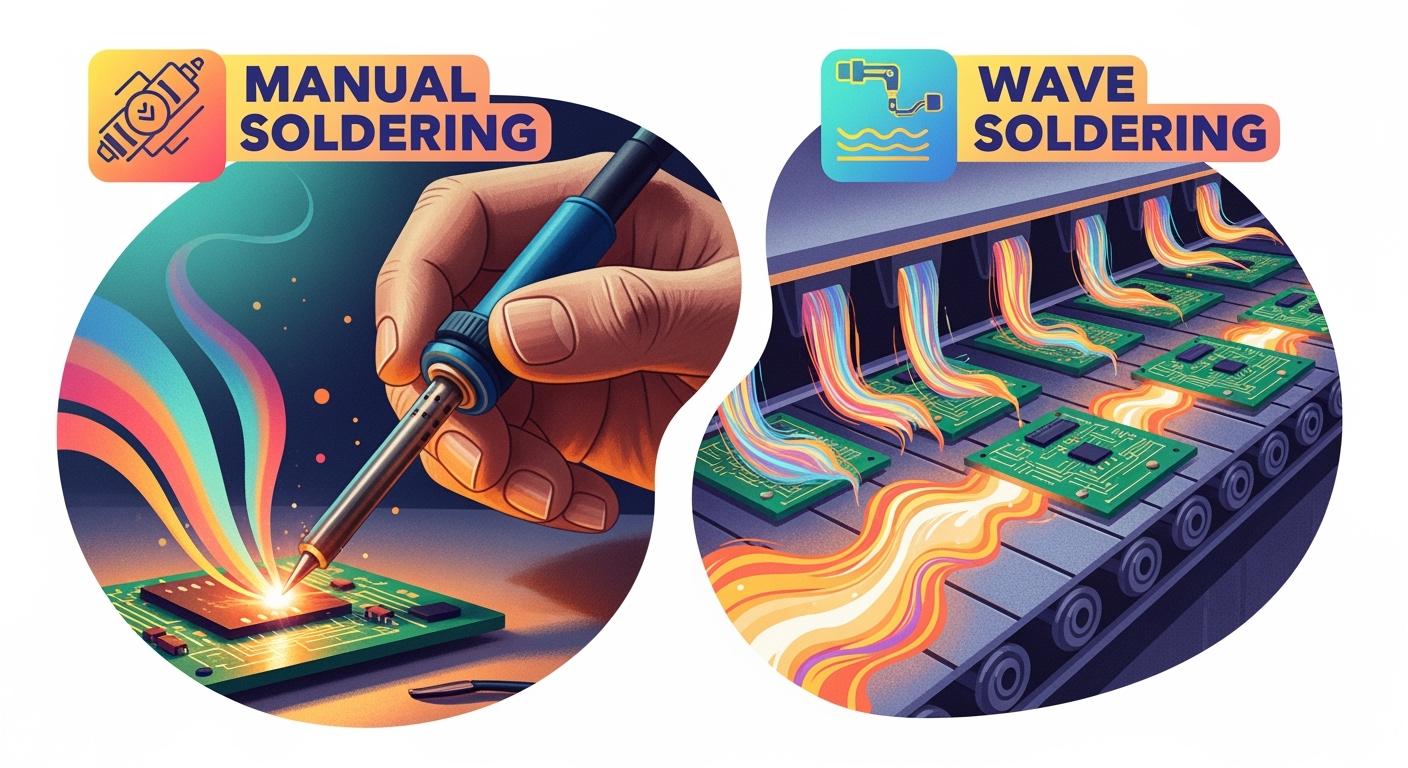
When you choose between manual and wave soldering, your specific needs are the top priority. Manufacturers often prefer manual soldering for prototypes and small production batches because it allows for quick design changes and avoids lengthy setup times. On the other hand, wave soldering is ideal for large-scale projects, as it processes boards much faster and reduces the cost per board when producing in high volumes.
Key factors to consider include cost, speed, quality, reliability, scalability, and board compatibility.
| Aspect | Wave Soldering | Manual Soldering |
|---|---|---|
| Speed | 60–120 boards per hour | 80–150 pins per hour |
| Cost | High initial investment, lower cost per board with volume | Low equipment cost, but higher labor costs for large jobs |
| Quality | Consistent results, great for connectors | Greater control for delicate components |
Key Takeaways
- Pick manual soldering for prototypes and small batches. It lets you make quick changes. The starting cost is low.
- Wave soldering is good for big production jobs. It makes boards faster. It lowers the cost for each board when you make many.
- Think about the parts you use. Manual soldering is good for delicate parts. Wave soldering works best for through-hole components.
- Look at what your production needs are. Manual soldering gives you flexibility. Wave soldering gives you steady results and speed for big jobs.
- Always check your soldering process. Good habits and inspections stop common mistakes. They help make strong solder joints.
Manual, Wave Soldering Overview
Manual Soldering Process
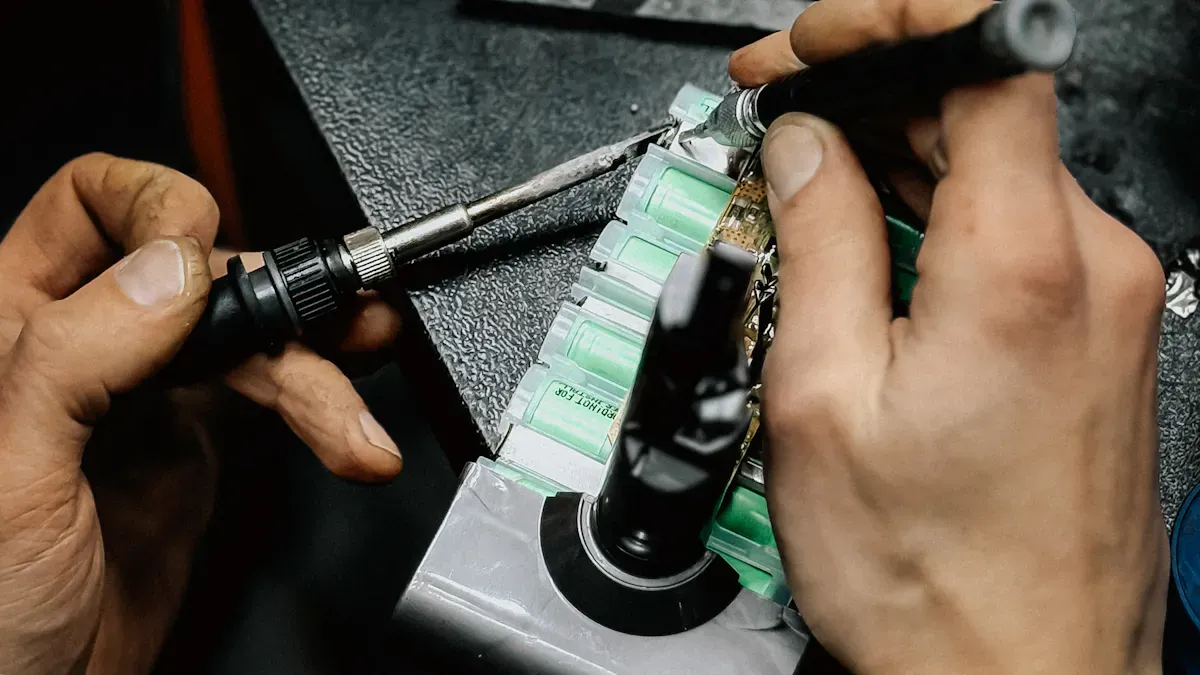
Manual soldering means you do each step by hand. You hold the soldering iron and touch it to the lead and pad. The solder melts and makes the joint. Each joint takes about 1 to 3 seconds. A skilled worker can solder 80 to 150 pins in one hour on a medium board. If you use high-density or multi-row connectors, you may go slower. Manual soldering can leave more flux behind, so you might need to clean the board after. This way gives you more freedom and lets you fix mistakes fast. Many people like hand soldering for prototypes or small, delicate parts.
Wave Soldering Process
Wave soldering uses a machine to solder many joints at once. You put your board on a moving belt. The board goes over a wave of hot solder. All the pins on the bottom get soldered in just a few seconds. For example, wave soldering can finish 100 joints in about 6 seconds. The machine puts flux on evenly, which helps keep the board clean. Preheating the board helps protect sensitive parts from heat. Wave soldering is fast and can handle big batches with steady results.
Key Differences
There are some main differences between manual and wave soldering. Manual soldering gives you more control but takes more time and puts more heat in one spot. Wave soldering is much faster and spreads heat out, which keeps parts safe. The table below shows how flux and heat compare:
| Soldering Method | Flux Residues | Thermal Load |
|---|---|---|
| Manual Soldering | Tends to produce extreme residues | Higher localized thermal load due to small tip |
| Wave Soldering | Applies flux uniformly, reducing residues | Manages thermal stress more effectively |
Both ways make strong solder joints, but wave soldering is better for making lots of boards. Manual and wave soldering both have uses in electronics, and you should pick what fits your needs.
Strengths and Limitations
Manual Soldering Strengths
You gain flexibility with manual, wave soldering. Manual soldering techniques let you work with many types of components, even fragile ones that cannot handle high heat. You can fix mistakes quickly and make changes on the spot. This method works well for prototypes and small batches. You do not need expensive machines, so your initial costs stay low. You can also control each solder joint, which helps when you need precision.
Manual Soldering Limitations
Manual soldering has some clear drawbacks. You need skill to keep parts steady and make good solder joints. If you have both large and small components, you may see uneven heating. This can cause weak solder joints on smaller parts. You also risk damaging sensitive components if you apply heat for too long. Here are some common issues:
- Both hands stay busy, making it hard to hold parts in place.
- Inconsistent heating can lead to poor solder joints.
- Fragile parts may get damaged from too much heat.
Wave Soldering Strengths
Wave soldering shines in high-volume production. You can solder many joints at once, which boosts your speed and lowers your cost per board. This method works best for through-hole components, which remain common in many designs. You do not need to apply solder paste or use masking, which saves time. The process gives you consistent solder joints across all boards.
| Advantage | Description |
|---|---|
| Speed | You finish more boards in less time. |
| Cost-effectiveness | Lower cost per board for large runs. |
| Through-hole compatibility | Handles through-hole parts with ease. |
Wave Soldering Limitations
Wave soldering does not fit every job. Some sensitive parts, like connectors and diodes, cannot handle the high temperatures. The setup takes time and adds cost, especially for small batches. You may see solder bridges or shorts if the solder does not flow just right. This method lacks the precision of other soldering techniques, so reliability can suffer if you do not optimize the process.
Note: Manual, wave soldering each have unique strengths and weaknesses. You should match your choice to your production needs and the types of solder joints you require.
Comparison
Speed and Throughput
You want to finish your boards quickly. When you look at speed comparison, wave soldering stands out. This method can process between 60 to 120 boards per hour. You can solder 100 joints in just 6 seconds with wave soldering. Manual soldering takes much longer. If you solder by hand, you need about 3 seconds for each joint. For a board with 100 joints, you spend about 5 minutes. This big difference in speed means wave soldering works best for large batches. You get more boards done in less time.
- Wave soldering: 60–120 boards per hour
- Manual soldering: 100 joints take about 300 seconds (5 minutes)
If you need high throughput, wave soldering is the clear winner.
Cost Factors
You need to think about cost analysis before you choose a method. Manual soldering has a low equipment cost. You can start with a soldering iron that costs less than $200. But as you make more boards, labor costs go up. Wave soldering needs a big investment at first. Machines can cost from $3,000 to $350,000, depending on how advanced they are. You also pay for maintenance, flux, solder bars, and sometimes nitrogen. For small batches, manual soldering is cheaper. When you make more than 200–500 boards, wave soldering becomes more cost-effective.
| Soldering Method | Equipment Cost | Maintenance Costs | Labor Cost per Board | Break-even Point |
|---|---|---|---|---|
| Wave Soldering | High | Ongoing (flux, solder, nitrogen) | Low for large batches | 200–500 boards |
| Manual Soldering | Low (under $200) | Minimal (solder wire, flux) | High for mass production | 200–500 boards |
You save money with manual soldering for prototypes or small runs. For big jobs, wave soldering lowers your cost per board.
Quality and Reliability
You want your solder joints to last. Wave soldering gives you more consistent results. The process follows strict rules for contact time and wave height. This matches IPC standards for quality and reliability comparison. You get uniform fillet shapes and better wetting, especially on large pins. Manual soldering lets you control each joint, but you may see more variation in fillet size. If you do manual soldering well, your joints can pass electrical tests. Still, wave soldering usually has lower defect rates and more reliable results over time.
- Wave soldering: Consistent thermal profile, lower defect rates, meets IPC standards
- Manual soldering: More control, but higher risk of defects and thicker intermetallic compounds
Scalability
You need to think about how your process will grow. Manual soldering works for small batches or prototypes. If you try to scale up, you need more skilled workers. This makes it hard to keep up with demand. Wave soldering handles large volumes with ease. You can run hundreds or thousands of boards with the same setup. The process stays fast and steady, even as you grow. If you plan to scale your production, wave soldering is the better choice.
Defect Rates
You want to avoid mistakes in your solder joints. Wave soldering gives you more uniform joints and fewer defects. The process controls heat and solder flow, so you see fewer bridges and shorts. Manual soldering can lead to more defects, especially if the operator is not skilled. You may see uneven fillets or cold joints. Selective soldering, a type of controlled soldering, can cut bridging defects by 80% compared to wave soldering. Still, for most mass production, wave soldering keeps defect rates low.
Operator Skill
You need to consider the skill level of your team. Manual soldering depends on the operator’s hands and eyes. You need formal training and practice to make good solder joints. This raises your training costs. Wave soldering is more automated. You set up the machine, and it does the work. You still need to know how to run the machine, but you do not need as much skill as with manual soldering.
Manual soldering requires a high level of skill and judgment. Wave soldering is more automated and produces consistent results with less training.
Board Compatibility
You must match your soldering techniques to your board type. Wave soldering works best for through-hole technology (THT) components. It can also handle some surface-mount technology (SMT) parts if the board design allows. This method is great for large panels and mass production. Manual soldering gives you more flexibility. You can work with delicate or heat-sensitive parts. You can also fix problems or add special components by hand. If your board has many THT parts, wave soldering is a strong choice. For mixed or complex boards, manual soldering may fit better.
You should always choose the method that matches your board design and production needs.
Choosing a Method
Prototyping
When you make prototypes, you need to work fast. Manual soldering gives you lots of control. You can fix mistakes right away and change things quickly. This way costs less because you do not need big machines. You only need a soldering iron and some simple tools. If you want to try new ideas or layouts, manual soldering helps you move fast.
You might also use selective soldering for tricky or delicate parts. Selective soldering only heats certain spots and keeps fragile parts safe. This method is good when you want strong solder joints on just a few boards.
- Manual soldering: Great for quick changes, low cost, and easy fixes.
- Selective soldering: Good for careful work and sensitive parts.
Tip: For prototypes, pick manual soldering if you want to save money and work fast. Use selective soldering if your board has tight spaces or parts that cannot take much heat.
Small Batch Production
Small batch jobs need you to think about time and money. Manual soldering works well because you can start right away. You do not waste time setting up machines. Your tools are cheap, but labor costs can go up if you have many boards.
Wave soldering is better if you make more than a few hundred boards. It takes longer to set up and costs more at first, but you save money on each board as you make more. Look at the table below to compare both ways:
| Method | Setup Time | Cost Efficiency |
|---|---|---|
| Manual Soldering | Very little setup | Cheap tools, but more work for people |
| Wave Soldering | More setup needed | Expensive at first, but cheaper per board if you make a lot |
If you want to spend less and need to change things, manual soldering is best. If you plan to make the same board many times, wave soldering saves money later.
Mass Production
Mass production needs you to work fast and make boards the same every time. Wave soldering is best for this. You can solder many boards at once, so you finish faster. This way works best for through-hole parts and simple boards. You get the same solder joints on every board, which makes them strong.
- Fast soldering: You finish lots of boards quickly.
- Through-hole parts: Wave soldering is good for these.
- Strong solder joints: The process makes good connections.
- Saves money: You do not need as many workers.
Manual soldering is too slow and not as steady for big jobs. If you want to grow your business and keep boards good, wave soldering is the best way.
Note: For big jobs, wave soldering helps you finish on time and keep quality high.
Complex Boards
Complex boards have both surface-mount and through-hole parts. They may be crowded or have fragile pieces. Manual soldering lets you work carefully in small spaces. You can focus on each joint and keep other parts safe.
Selective soldering is also good for tricky boards. It only heats the spots you want and keeps the rest cool. This helps protect parts that cannot take much heat or when the board is crowded.
- Selective soldering: Good for crowded boards.
- Manual soldering: Lets you fix special parts and do repairs.
- Wave soldering: Works for simple areas but not for crowded spots.
If your board has both SMT and THT parts, or you need to protect some areas, use selective or manual soldering. Wave soldering is best for simple, open boards.
Tip: For tricky boards, use ways that let you work carefully. This helps you stop mistakes and make strong solder joints.
Common Pitfalls
Manual Soldering Issues
When you use manual soldering, you may face several problems that can affect your solder joints:
- Cold solder joints happen when the solder does not bond well. This makes weak connections that can fail.
- Solder bridges form when solder connects two pins or pads by mistake. This can cause short circuits.
- Insufficient solder leads to incomplete or weak solder joints.
- Lifted pads occur if you overheat the board. The pad can come off the PCB, making repairs hard.
You should always check your work to catch these issues early.
Wave Soldering Issues
Wave soldering can also create problems if you do not set up the process correctly. Here are some common issues:
- Insufficient hole fill means the solder does not fill the holes for the components. This can make your solder joints unreliable.
- Lifted components can happen if the board flexes or the leads are too long.
- Excessive solder may build up on connections, making the board hard to inspect or repair.
- Solder balling leaves small balls of solder on the board. This often happens if the solder temperature is too high or the flux is not right.
Tip: Always monitor your process and inspect boards after soldering to catch these problems.
Best Practices
You can avoid most pitfalls by following some best practices:
- Design your PCB with enough space between pads to prevent solder bridges.
- Choose the right solder alloy for your needs. Alloys like SAC305 work well for lead-free solder joints.
- Apply flux carefully. Too much flux can leave residues, while too little can cause poor solder joints.
- Train your operators well. Skilled workers make better solder joints and spot problems faster.
- Keep your equipment clean and well-maintained to ensure good results.
- Use quality control checks to find and fix defects early.
| Technique | Benefit |
|---|---|
| Advanced PCB Design | Helps you get reliable solder joints |
| Regular Maintenance | Reduces defects and improves consistency |
| Operator Training | Leads to stronger, more reliable solder joints |
Remember: Good process control and careful inspection help you make strong, reliable solder joints every time.
You need to pick the right soldering method for your job. Manual soldering is good for making prototypes and small batches. Wave soldering works well for big jobs and complex boards. Think about important things before you decide:
| Factor | Manual Soldering | Wave Soldering |
|---|---|---|
| Component Types | Works best for through-hole parts | Handles through-hole and bigger parts |
| Board Complexity | Good for simple boards | Great for complex, crowded boards |
| Production Volume | Best for small amounts | Saves money for big amounts |
| Budget Constraints | Costs more for workers | Cheaper for big jobs |
| Environmental Regulations | Changes with each process | May have stricter rules |
| Required Throughput | Makes fewer boards | Makes more boards faster |
| Flexibility for Future Products | Not very flexible | Easier to change for new products |
Think about what you need and want. For help, look at guides from Harris Products Group or the Ultimate Guide to Electronic Soldering.
FAQ
What type of soldering should you use for mixed technology boards?
Manual soldering or selective soldering are good choices for mixed technology boards. These ways let you work with surface-mount and through-hole parts. You can avoid hurting sensitive components.
Can you use wave soldering for small batches?
Wave soldering is best for big batches. If you use it for small runs, setup takes more time and costs more money. You might not save much in production. Manual soldering is usually better for small batches.
How do you reduce soldering defects?
- Teach your workers how to solder well.
- Use the right amount of flux.
- Keep your tools clean.
- Check boards after soldering.
These steps help you stop problems like cold joints and solder bridges.
Is manual soldering safe for sensitive components?
Manual soldering lets you control the heat. You can keep sensitive parts safe by using lower heat and working fast. Always look at the component’s datasheet to find safe temperature limits.