
 English
 Arabic
 Chinese (Simplified)
 Dutch
 French
 German
 Italian
 Portuguese
 Russian
 Spanish

NTC vs PTC Thermistor: Electronics and Sensor Guide
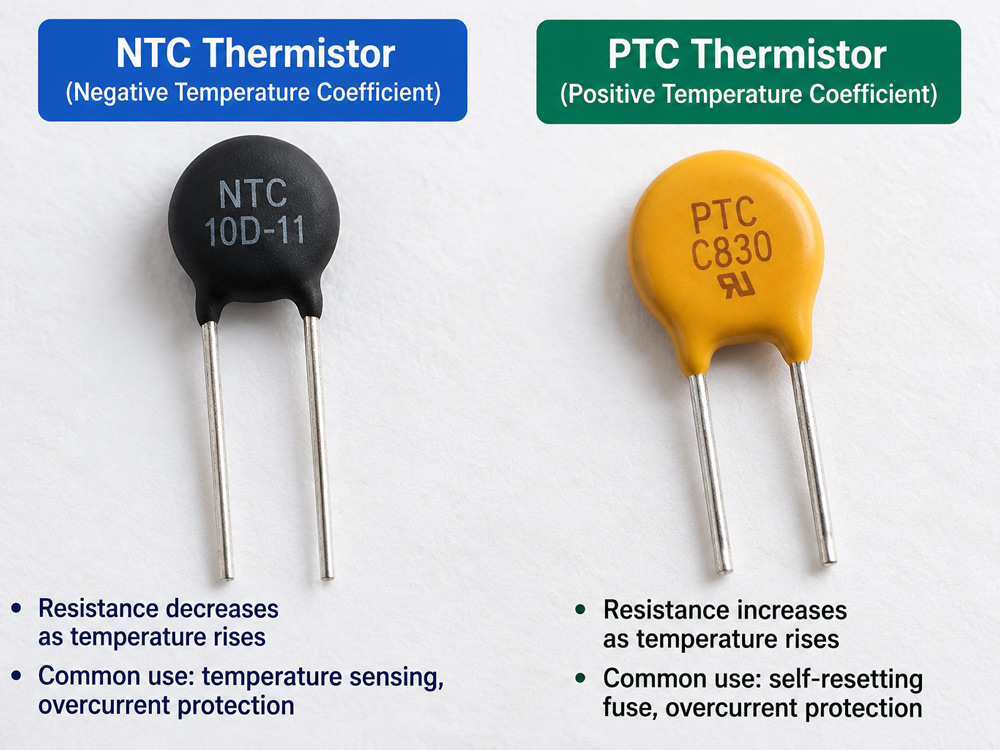
Quick Answer: Main Difference Between NTC and PTC Thermistors
When comparing PTC vs. NTC thermistor technologies, the key difference lies in how their resistance responds to temperature—a property central to their use in temperature-sensitive resistor applications.
- NTC Thermistor: “NTC” stands for Negative Temperature Coefficient. In an NTC thermistor, resistance decreases as the temperature increases. These are widely used for temperature sensing, precise measurement, and controlling inrush current in electronics.
- PTC Thermistor: “PTC” stands for Positive Temperature Coefficient. Here, the resistance increases as temperature rises. PTC thermistors are best suited for overcurrent protection, self-regulating heaters, and as resettable fuses in circuits.
“The difference between NTC and PTC thermistors isn’t just academic – your application may depend critically on choosing the right type for safety, reliability, and measurement accuracy.” — Embedded Systems Design Journal
What Is a Thermistor?
A thermistor is a special type of temperature-sensitive resistor whose resistance changes predictably with temperature. The term “thermistor”—a contraction of “thermal” and “resistor”—encompasses two main types: NTC (Negative Temperature Coefficient) thermistors and PTC (Positive Temperature Coefficient) thermistors.
At their core, thermistors are made from semiconductor materials whose electrical resistance varies according to temperature changes. This predictable resistance-temperature relationship is why they’re invaluable in electronic circuits for temperature sensing, compensation, and regulation.
Key thermistor facts:
- Thermistor resistance–temperature curve: Each thermistor follows a characteristic resistance-vs-temperature (R-T) curve which forms the basis for its use in analog monitoring and protection.
- R25 resistance: This value—resistance at 25°C—is commonly referenced when specifying thermistors (e.g., “10K NTC thermistor” implies 10,000 ohms resistance at 25°C).
- B value: A thermistor constant that indicates how rapidly resistance decreases (NTC) or increases (PTC) with each degree of temperature change—crucial for sensor calibration and accuracy.
- Applications: Thermistors are found in everything from household appliances and industrial controllers to battery management systems (BMS), medical equipment, and automotive sensors.
Quote: “The power of a thermistor lies in its simplicity—it turns a complex measurement into a single, continuous electrical value.” – Power Electronics World
Thermistors are chosen for their:
- Small size (often available as beads, discs, or SMD chips)
- Rapid response to temperature changes
- High sensitivity and accuracy over narrow temperature ranges
What Is an NTC Thermistor?
Basics of NTC Thermistors
NTC thermistors (Negative Temperature Coefficient thermistors) exhibit a decrease in resistance as temperature increases—a property defined by the negative temperature coefficient. This behavior makes the NTC thermistor ideal for applications that require accurate temperature sensing, measurement, and control.
NTC thermistor resistance behavior:
- At low temperatures, the resistance is high.
- As the temperature rises, the resistance falls sharply.
- The relationship is exponential rather than linear, which is why NTC thermistors are well-suited for precise temperature detection within a specific range.
Key parameters:
- R25: The resistance at 25°C, e.g., 10K NTC thermistor = 10,000Ω at 25°C.
- B value: Indicates how steeply resistance will drop for a given rise in temperature.
Core Applications:
- Temperature Sensing: Used in digital thermometers, HVAC temperature sensors, and PCB temperature sensing because of their accuracy and stability.
- Inrush Current Limiting: Power NTC thermistors are inserted in series with the power supply to limit the surge of current when devices like switching power supplies or large capacitors are first powered on (NTC inrush current limiter).
- Temperature Compensation: Frequently used to stabilize voltage references and clock circuits against temperature drift.
- Battery Management: Used as a temperature sensor in battery chargers and battery management systems (BMS) to monitor and protect cells from overheating.
Case Study: A major manufacturer of 3D printers incorporates NTC thermistors into the hot end and heated bed. The thermistor’s fast, predictable response time allows precise PID temperature control, leading to higher quality prints and safer operation.
Why choose NTC for temperature sensing?
- Wide resistance range for analog circuits (e.g., used in a voltage divider and ADC setup).
- Available in many package types: beads, discs, and probes for harsh or protected environments.
What Is a PTC Thermistor?
PTC thermistors (Positive Temperature Coefficient thermistors) work in the opposite manner to NTCs—their resistance increases with temperature. This rise can be gradual (linear) or very steep (switch-like) at a certain switching temperature. PTC thermistors’ main advantage lies in their reliability for overcurrent protection, thermal cutoff, and self-regulating heating.
Types of PTC Thermistors
- Ceramic PTC thermistors (Switching PTC): Typically made from barium titanate. Exhibits a sharp increase in resistance at a specific temperature threshold (Curie temperature), making them act almost like a switch.
- Polymer PTC thermistors (PPTC/Resettable fuses): Constructed from a polymer doped with conductive particles. They increase resistance abruptly when a preset max temperature is reached, opening the circuit until they cool down and automatically reset.
PTC Thermistor Applications
- Overcurrent protection: Inserted in series with a supply or load. If too much current flows, the PTC heats up and its resistance soars, effectively limiting current—a valuable overcurrent protection feature in USB rails, low-voltage power, and consumer electronics.
- Self-Restting Fuses: PPTC (Polymer Positive Temperature Coefficient) thermistors function as resettable fuses. Once tripped due to overcurrent, they recover after cooling without needing replacement—a key advantage in battery management systems and USB protection.
- Motor Winding Protection: Embedded in transformer or motor windings to shut down circuits when temperatures rise above safe levels.
- Heater Elements: Used as small, self-regulating heating elements in de-misting mirrors, sensor heaters, and battery warmers.
PTC Parameters:
- Hold current and trip current:
- “Hold current” (I_hold) is the maximum steady-state current before the PTC trips.
- “Trip current” (I_trip) is the minimum current likely to open the PTC. These parameters guide selection for proper circuit protection.
Illustrative Example: Many modern laptop USB ports incorporate a PPTC resettable fuse (a type of PTC thermistor). When a fault occurs—such as a short circuit from a damaged cable—the PTC device heats up, drastically increases its resistance, and “opens” the circuit, protecting the laptop and device. Once the fault is cleared and the device cools, it resets and operation resumes.
NTC vs. PTC Thermistor: How They Work
Understanding thermistor differences requires looking deeper into NTC vs. PTC thermistor resistance behaviors, their circuit functions, and forms of integration.
Resistance-Temperature Relationship
NTC Thermistor Resistance–Temperature Curve:
- Shows steep, predictable decrease in resistance as temperature rises.
- Well characterized by the Beta (B) value in specifications.
- Used for analogue temperature feedback and precise measurement.
PTC Thermistor Resistance–Temperature Curve:
- Switching PTC: Shows flat resistance until a critical threshold, then rises rapidly—ideal for protection and switching.
- PPTC/Resettable fuse: Gradually increases resistance as current or temperature increases, then “trips” as protection.
| NTC Thermistor | PTC Thermistor | |
|---|---|---|
| Resistance Change | Decreases with heat | Increases with heat |
| Curve Shape | Exponential | Step (Switching) or gradual (PPTC) |
| Linear Region | Narrow | Can be wide (PPTC), step-like (ceramic) |
Circuit Functions
- NTC Thermistor in Temperature Feedback Circuits: Used in voltage divider circuits with ADC (Analog-to-Digital Converter) inputs for real-time temperature measurement.
- PTC Thermistor in Protection Circuits: Used for overcurrent, overtemperature, or self-heating cutoff functions—prevents damage and enhances circuit safety.
Forms and Integration
- NTC Thermistor Sensors and Probe Assemblies: Integrated into cables, waterproof sleeves, and PCB-temperature sensor packages for versatile usage.
- PTC Thermistor Protection and Heating Devices: Molded as discs, chips, or surface-mount devices for direct PCB integration or cable-side protection.
NTC vs. PTC Thermistors
An at-a-glance NTC vs. PTC thermistor comparison table showing essential differences in behavior, application, and parameters:
| Feature | NTC Thermistor | PTC Thermistor |
|---|---|---|
| Response to Temperature | Resistance decreases | Resistance increases |
| Coefficient Sign | Negative temperature coefficient | Positive temperature coefficient |
| Typical Applications | Temperature sensing, inrush current limiting | Overcurrent/overtemp protection, resettable fuse, heating |
| Common Specifications | R25, B value | Switching temp, I_hold, I_trip |
| Typical Sensing Range | -55°C to 150°C | 0.5A to 10A hold current, varies |
| Mounting Options | Beads, discs, probes, SMD | Discs, SMD, polymer strips |
| Resettable? | No | Yes (PPTC types) |
| Integration Example | PCB temp sensing, digital thermometers | USB protection, motor thermal cut |
Application Fit: Where Are PTC and NTC Thermistors Used?
Understanding thermistor applications is key for smart and safe electronics design. Different tasks—temperature sensing, inrush current limiting, overcurrent protection, and self-regulating heating—require different thermistor types due to their inherently opposite resistance-temperature relationships.
NTC Thermistor Application Examples
- Appliance and HVAC Sensing: NTC thermistors are the standard choice for HVAC temperature sensors, digital thermostats, oven temperature monitoring, and refrigerator controls. Their accurate and rapid response to temperature shifts ensures precise environment regulation.
- PCB Temperature Sensing: Modern electronics often rely on NTC thermistors for on-board thermal monitoring—protecting CPUs, power transistor arrays, and high-power LEDs from overheating.
- 3D Printer Thermistors: 3D printers use NTC thermistors for constant monitoring of the hot-end and heated bed, balancing temperature for smooth and high-resolution prints.
- Battery Packs and Battery Management Systems (BMS): NTC thermistors monitor battery cell temperatures, providing essential protection from “thermal runaway” and increasing charging safety.
Interesting Fact: The ubiquitous 10K NTC thermistor (with B value near 3950) is the global default for cost-effective, accurate temperature sensing in low-voltage circuits.
PTC Thermistor Application Examples
- Power Supply and Inrush Current Limiting: PTC thermistors act as “soft-start” devices, suppressing current spikes when a device is plugged in cold, then increasing resistance to limit current as components heat.
- Overcurrent Protection (Resettable Fuse): In USB power ports, battery systems, and industrial control, Polymer PTC thermistors (PPTC) are vital for circuit safety. They open the circuit in the event of an overcurrent, then automatically reset—a huge advantage over single-use fuses.
- Motor and Transformer Protection: PTC thermistors are built into the windings of motors and large transformers. If temperature climbs to unsafe levels, the steep jump in thermistor resistance signals controllers to cut power or shut down the device.
- Self-Regulating Heating Elements: PTC elements are found in anti-fog mirrors, pipe warmers, and even heated clothing. As the element warms, its resistance increases, naturally capping power output for self-regulating heating without external control.
At a Glance: Which Thermistor Suits Which Application?
| Scenario | Type Preferred | Example Products |
|---|---|---|
| Continuous temperature sensing | NTC Thermistor | Thermometers, BMS, HVAC sensors |
| Startup inrush current limiting | NTC Thermistor | Power NTC thermistor (SMPS, motors) |
| Resettable overcurrent protection | PPTC/Polymer PTC | USB ports, battery packs |
| Motor winding overheat protection | Ceramic PTC | Transformers, large motors |
| Self-regulating heating | PTC Thermistor | Heating pads, anti-condensation mirrors |
How to Choose Between NTC and PTC Thermistors
Making the correct thermistor choice can make or break a design. The difference between NTC and PTC thermistors is not just academic—using the wrong type can lead to unreliable temperature readings or, worse, circuit failure.
Consider These When Selecting a Thermistor:
- Purpose:
- For accurate temperature sensing or temperature compensation, always opt for NTC thermistors. They provide smooth, predictable analog signals.
- For resettable overcurrent protection (such as USB rails, BMS), polymer PTC (PPTC) thermistors are unrivaled.
- Operation Mode:
- If you need to measure gradual or wide-ranging temperatures, NTC is best.
- For circuits needing automatic shutdown or reset upon overheating or overcurrent, PTC is the smart choice.
- Parameters to Check:
- NTC: Required resistance at 25°C (R25), B value, response time, power rating.
- PTC: Hold and trip current, switching temperature, reset characteristics, time-to-trip.
- Installation Environment:
- For PCB applications, SMD thermistors save space and thermal lag.
- For harsh or wet locations, probe-encased or coated thermistors offer better protection and accuracy.
- Thermal Coupling and Sensor Placement:
- Bad placement or poor thermal contact can cause dangerously misleading readings. Thermal grease, direct contact, or integrated mounting holes are critical for accuracy.
Common Thermistor Selection Mistakes
Thermistor selection mistakes on PCBs and in product designs are more common than many engineers care to admit. Avoid these common pitfalls:
- Choosing the wrong coefficient: Using a PTC when an NTC is required for precise measurement can lead to non-functional feedback systems.
- Ignoring response time: Poor placement or excessive thermal mass delays sensor response, compromising protection or feedback.
- Mismatched ratings: Neglecting to check R25, B value, or current ratings can leave you with sensors that are too slow, too inaccurate, or prone to self-heating failure.
- Overlooking “self-heating”: In high-current temp sensors, self-heating can skew readings far above ambient temperatures (“Thermistor self-heating”)—never exceed rated power.
- Not validating installation: Failing to test under real-working conditions can produce catastrophic results, especially in safety or medical products.
Selecting the Right Thermistor: Tips & Factors
The how to choose a thermistor process gets much easier with this shortlist:
- Check the Resistance–Temperature Curve: Match the thermistor’s curve or table to your temperature sensing or protection range.
- Consider Tolerance and Accuracy: Lower tolerance means more precise readings; always weigh your spec against your application’s needs.
- Account for the Required Reaction Time: Fast-response NTCs are critical for rapid safety shutoffs.
- Mounting Options: Choose SMD or probe style based on your PCB layout and environment.
- Test Under Actual Conditions: Lab test isn’t enough—mount sensors on your PCB, power up, and measure against reference instruments.
- Plan for Replacement/Reset: If you need a fuse that can reset, opt for PPTC; if not, a single-use fuse or thermal cutoff might suffice.
Can NTC and PTC Thermistors Replace Each Other?
Short answer: Generally, no—NTC and PTC thermistors are NOT interchangeable, except in very specific overtemperature or simple protection circuits where only the general “temperature threshold” is needed.
Why Can’t They Be Swapped?
- NTC for analog, PTC for binary: If you swap a PTC into a temperature sensing circuit designed for NTC, the feedback loop reverses: as the device gets hotter, the system thinks it’s getting colder! This can cause catastrophic failure in heating, cooling, or temperature-dependent bias circuits.
- Switching Characteristics: NTC thermistors provide smooth, continuous output, while PTC (especially ceramic) have sharp switching, unsuitable for analog temperature readings.
- Protection Behavior: Only PPTC/Polymer PTCs offer true resettable fuse behavior; NTCs are fundamentally unsuitable for this kind of protection.
Exceptions: In some heater circuits or crude thermostats, any device with a “change in resistance at temperature” might suffice. But this is almost never recommended for reliable, safe designs.
Frequently Asked Questions
Q: What is the main difference between NTC and PTC thermistors?
A: NTC thermistors decrease resistance as temperature increases (for sensing and compensation); PTC thermistors increase resistance as temperature rises (for protection, switching, or self-resetting fuses).
Q: Is NTC or PTC better for temperature sensing?
A: NTC thermistors are vastly superior for analog/continuous temperature measurement thanks to their smooth resistance-temperature relationship.
Q: Can both types limit inrush current?
A: NTC thermistors are the preferred choice for inrush current limiting. PTCs are rarely used for this due to their step-resistance jump at the switching temperature.
Q: What does 10K NTC mean?
A: This refers to an NTC thermistor with a resistance of 10,000 ohms (10KΩ) at 25°C (room temperature). This is commonly called the R25 value and is a standard for temperature sensing circuits—particularly for digital controllers and analog-to-digital converter inputs.
Q: Is a PTC thermistor the same as a resettable fuse?
A: Not quite. All polymer PTC thermistors (PPTC) function as resettable fuses, but not all PTC thermistors are PPTCs. Ceramic PTCs, for instance, serve as thermal switches and aren’t resettable fuses. PPTCs are specifically designed for overcurrent protection and self-reset upon cooling.
Conclusion
Choosing between PTC and NTC thermistors is foundational for safe, accurate, and reliable electronic circuits. The difference between NTC and PTC thermistors comes down to their response to temperature:
- NTC thermistors: Resistance decreases as temperature increases. Use these for accurate temperature sensing, compensation, and inrush current limiting tasks.
- PTC thermistors: Resistance increases as temperature rises. Use these for overcurrent and overtemperature protection, resettable fuses (PPTC), and self-regulating heating.